
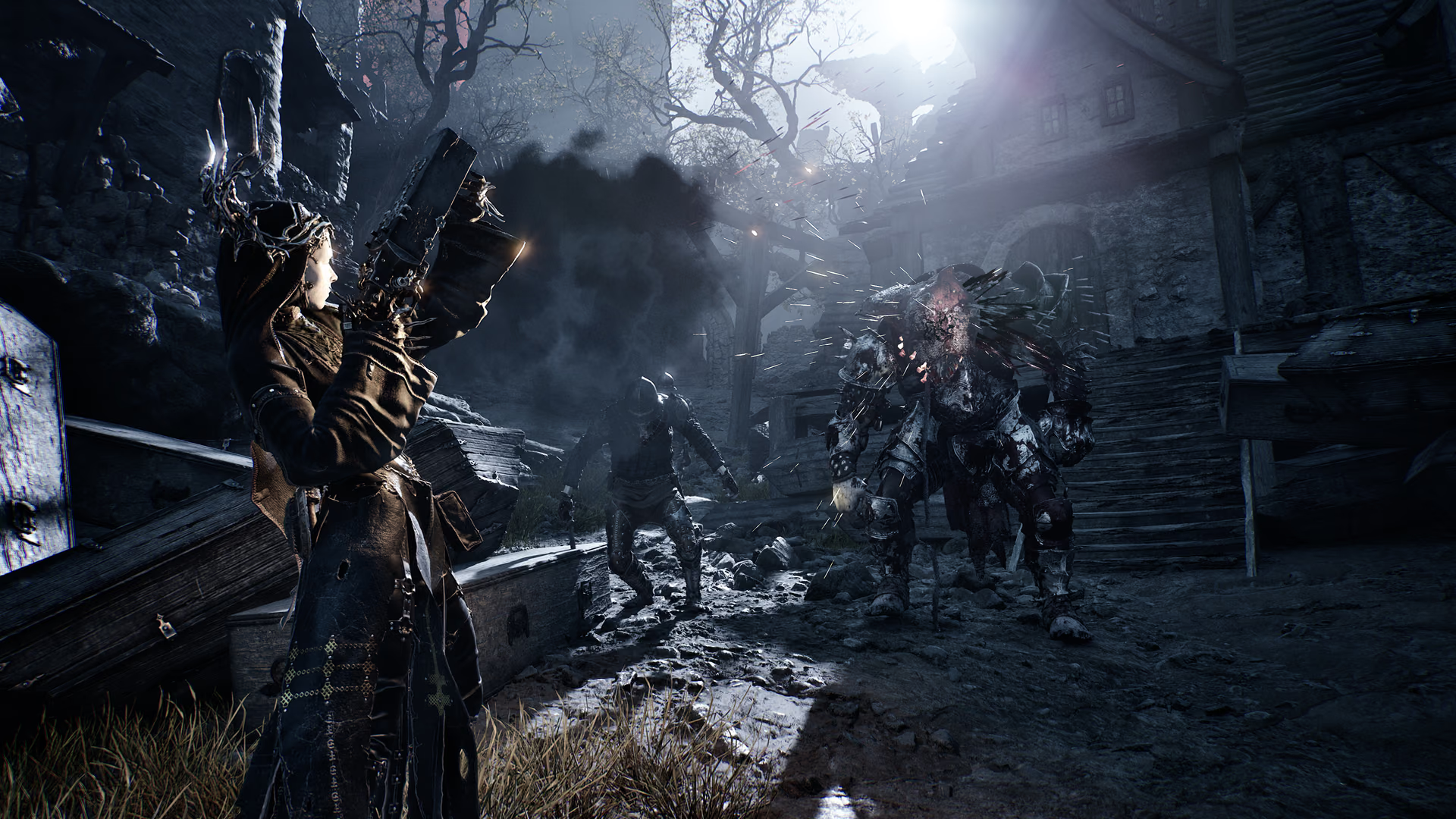
How to choose your sidearm
Test each candidate against a mobile enemy, a group, and a boss. Compare ammunition or Resolve demand, firing commitment, stagger, range, and whether your Shell can create a safe opening. The best result is the sidearm you can use consistently without starving your main combat loop. Source 1Rock Paper Shotgun best weapons and sidearmsOpen source
Best picks by job
| Need | Strong candidate | Tradeoff |
|---|---|---|
| Rapid boss pressure and stagger | Caged Hystrix | Needs steady investment and appropriate Tarstones |
| Crowd disruption | Troubadour's Lute | Limited direct damage and boss utility |
| General ranged exploration | Forgotten Crossbow | Loses some impact in later areas |
| Close-range burst | Naylshotte | Short effective range |
| Large single hit | Salvaged Trebuchaxe | Slow loading leaves you exposed |
| Heavy sustained fire | Triarch Repeater | Long wind-up demands a safe opening |
Rock Paper Shotgun places Caged Hystrix and Troubadour's Lute in its S tier, followed by Forgotten Crossbow, Naylshotte, and Salvaged Trebuchaxe in A. That ranking reflects the reviewer's build and checked patch, so treat the roles above as more durable than the letters.
The Week 1 Update redesigned Salvaged Trebuchaxe Tiltshot and fixed sidearm projectiles choosing the wrong target or failing to register against weak points. Re-test any launch-week ranking that depended on Tiltshot or unreliable targeting. Source 2The Week 1 UpdateOpen source
A simple test before upgrading
Equip the candidate without spending rare materials. Use it against a small group, a mobile elite, and a boss attempt. Record whether it interrupts, how often you are hit during the firing animation, and whether Resolve is available when you need it. If the sidearm duplicates your main weapon's weakness, switch roles instead of forcing more damage.
Fast melee benefits from a tool that reaches distant or airborne targets. Slow heavy weapons benefit from interruption or crowd control. Shell passives can change the resource calculation, so check the Shell roster and current weapon guide together.
Balance changes can move damage rankings quickly. The safest long-term choice is a sidearm whose range and firing commitment solve a recurring problem in your own build.
Candidate roles in detail
Rock Paper Shotgun's current comparison places Caged Hystrix and Troubadour's Lute at the top of its editorial list, with Forgotten Crossbow, Naylshotte, and Salvaged Trebuchaxe close behind. Source 1Rock Paper Shotgun best weapons and sidearmsOpen source Use that as a shortlist, not a universal answer.
Caged Hystrix
Use it as a candidate for repeated boss pressure and stagger when the build can support its resource and upgrade demands. Test whether the firing sequence fits a real recovery window. High output is not useful if the player is hit before the sidearm completes.
Troubadour's Lute
Treat the Lute as crowd disruption and control rather than direct boss damage. It is attractive when groups, not single-target output, cause the route to fail. Keep another answer for a boss that cannot be controlled in the same way.
Forgotten Crossbow
The Crossbow is the straightforward ranged exploration candidate. It can cover targets that a short primary weapon cannot safely reach. Recheck its impact in later regions rather than assuming an early success scales unchanged.
Naylshotte
Naylshotte is a close-range burst option. Its short effective range means the Shell still needs a safe approach and exit. It does not solve a build whose main weakness is reaching a distant or airborne target.
Salvaged Trebuchaxe
The Trebuchaxe offers a large committed shot, but loading and recovery create exposure. The Week 1 Update redesigned Tiltshot, so launch footage is not current evidence of its behavior. Source 2The Week 1 UpdateOpen source Test on the current patch before spending around an older build.
Triarch Repeater
The Repeater is a sustained heavy-fire candidate that needs a long, safe opening. It can complement a Shell such as Proxima thematically and mechanically, but the wind-up must fit the encounter. A boss that never grants that window can make a lower-ranked quick tool more valuable.
Match the main weapon
| Main weapon problem | Sidearm role to test |
|---|---|
| Short reach | Reliable ranged hit |
| Slow startup | Quick interruption |
| Weak group coverage | Crowd control |
| Low single-target burst | Committed damage during a known recovery |
| Unsafe pursuit | Pressure that does not require closing distance |
| Resource-heavy ability loop | Low-conflict option with a different demand |
Do not pair two tools that fail for the same reason. A slow heavy primary plus a slow heavy sidearm can leave no safe answer to a mobile enemy. A short primary plus short burst sidearm can make every distant target expensive.
Resource economy
Record what the sidearm consumes and how often the build can restore it. A sidearm available only once per long route may be a boss finisher rather than an exploration default. A weaker shot that is consistently available can solve more encounters.
Test the resource loop under ordinary play, not a fully stocked training state. If using the sidearm prevents a Shell ability or riposte needed for survival, the apparent damage gain has a hidden cost.
Firing commitment
Measure the complete sequence from input to the first safe dodge, Harden, or movement. Include aiming, wind-up, projectile travel, and recovery. A mobile target can leave the line before the projectile arrives, while a group can punish the recovery even when the shot lands.
The Week 1 Update fixed projectiles selecting the wrong target and failing to register against certain weak points. Source 2The Week 1 UpdateOpen source If an old review ranks a sidearm around those failures, repeat the test rather than preserving the old letter grade.
Three-target test
Use the same unupgraded sidearm against:
- a mobile ordinary enemy to test aim and startup;
- a small group to test control and camera pressure;
- a boss recovery to test commitment and resource value.
Record hits, interruptions, damage taken during use, and remaining resources. Then upgrade only the candidate that solves the intended job. Change one Tarstone or Shell interaction at a time.
Shell synergy
A Shell can create the opening a sidearm needs or make its resource demand easier to sustain. Proxima's movement and Lightning plan, for example, may favor repeated-hit or ranged tools, but her hook can also place her too close for a long wind-up. The Proxima guide explains that positioning risk.
Use the Shell roster to identify the ability loop, then choose a sidearm that supports it. Do not rank the same tool identically for every Shell.
Boss and exploration loadouts
One sidearm does not need to serve every area. For exploration, prioritize availability, safe range, and crowd recovery. For a boss, prioritize a known punish, interruption, or phase-specific need. Change at a Beacon after confirming the route rather than carrying an unsuitable favorite into every fight.
Troubleshooting
If a projectile misses a locked target or weak point, confirm Week 1 or later, range, elevation, line of sight, and target movement. Remove mods and other effects, then reproduce the same shot. If Tiltshot differs from a guide, compare the guide with the redesign date.
Report sidearm, level, Shell, Tarstones, target, location, resource state, platform, and build. This page was rechecked on September 3, 2026; roles are retained where they remain useful, while exact rankings stay editorial and patch-sensitive.
Before replacing a working sidearm, compare complete encounters rather than one shot. Count successful uses, damage received during recovery, resources consumed, and whether the original problem was solved. A higher damage number is not an upgrade when the tool is unavailable or unsafe at the required moment.


